
Coloradans are delaying health and dental care, taking on additional debt and forgoing activities they once enjoyed as the rising cost of living and affordability reshapes daily life across the state, according to new findings from the Colorado Health Foundation’s 2026 Pulse Poll.
For many Colorado families, economic pressures that emerged during the pandemic have become a defining feature of daily life. Rising costs continue to force difficult choices between basic necessities, fueling uncertainty for many Coloradans about whether they will be able to afford to stay in the state long term.
The 2026 Pulse Poll paints a picture of individuals and households making increasingly painful tradeoffs and facing increasing anxiety over rising costs.
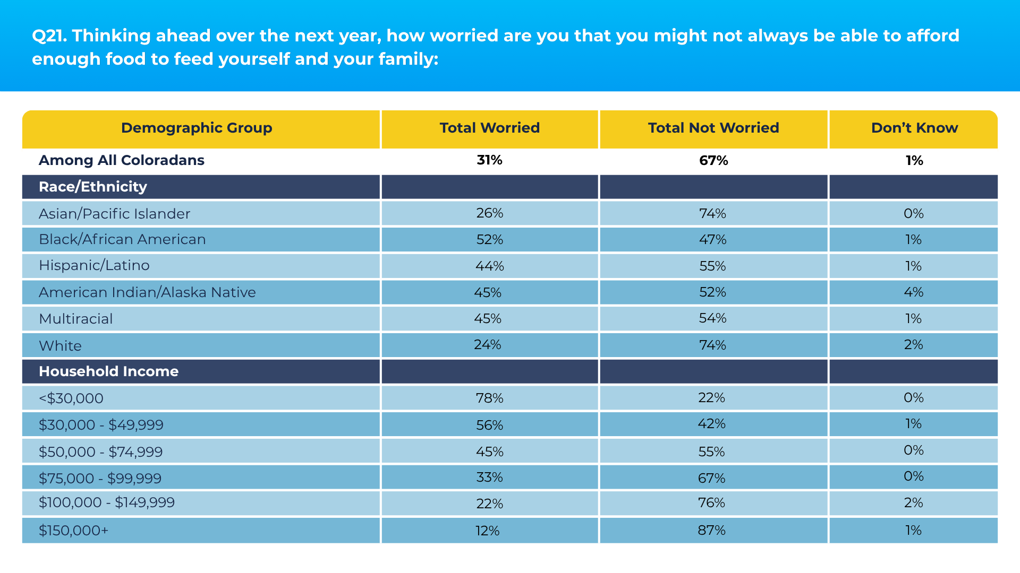
- Nearly one in five Coloradans (17%) reported skipping meals in the past year because they could not afford food, and nearly one-third (31%) worry about affording enough food in the year ahead;
- Nearly half (48%) postponed medical or dental care in the last year;
- 42% are worried that they or someone in their household will be without health coverage in the coming year;
- 32% of respondents said they are worried about losing their home in the coming year because they can’t afford their rent or mortgage;
- 29% delayed mental health treatment;
- More than one in five (22%) skipped or made a late utility payment;
- 73% cut back on recreation and entertainment spending; and
- 55% reduced their charitable giving.
These findings suggest that affordability challenges are no longer simply affecting household budgets, they are changing how people live, care for themselves and their families, support their communities and plan for the future. Many residents report feeling squeezed by the rising costs of housing, health care and everyday necessities, with concerns extending beyond immediate financial pressures to questions about long-term stability and quality of life. Three quarters (76%) worry they may not be able to afford living in Colorado in the future, up from 70% in 2025.
Economic challenges first documented in the Pulse Poll during the COVID-19 pandemic have not meaningfully subsided for many Coloradans. The 2026 Pulse Poll finds that affordability concerns continue to shape decisions large and small across Colorado. At the same time, frustration with government is growing, along with a desire for meaningful action to address the issues affecting people's lives. The findings arrive as Colorado prepares to elect a new governor and other statewide leaders in November 2026, offering a timely snapshot of the concerns shaping residents' views.
The 2026 Colorado Health Foundation Pulse Poll was conducted by telephone and online from March 14 – April 9, 2026 among a representative sample of 2,240 Colorado adults. The poll measures opinions, experiences and attitudes related to health and wellbeing across the state. For visual graphs of the 2026 poll highlights, view the Data Highlights.
Many of these challenges are more pronounced among Latino, Black, American Indian/Alaska Native and lower-income households, highlighting persistent disparities in financial security and access to basic needs.
“Rising costs are still a major concern for Coloradans,” said Lucia Del Puppo, senior vice president at FM3 Research and Democratic pollster for the Pulse Poll. “After some slight improvements in 2025, those hardships have returned to prior levels, suggesting that recent cost increases have wiped out the improvements people saw when inflation eased.”
Cost of Living Remains Colorado’s Defining Challenge
Affordability concerns continue to dominate the issues facing Coloradans:
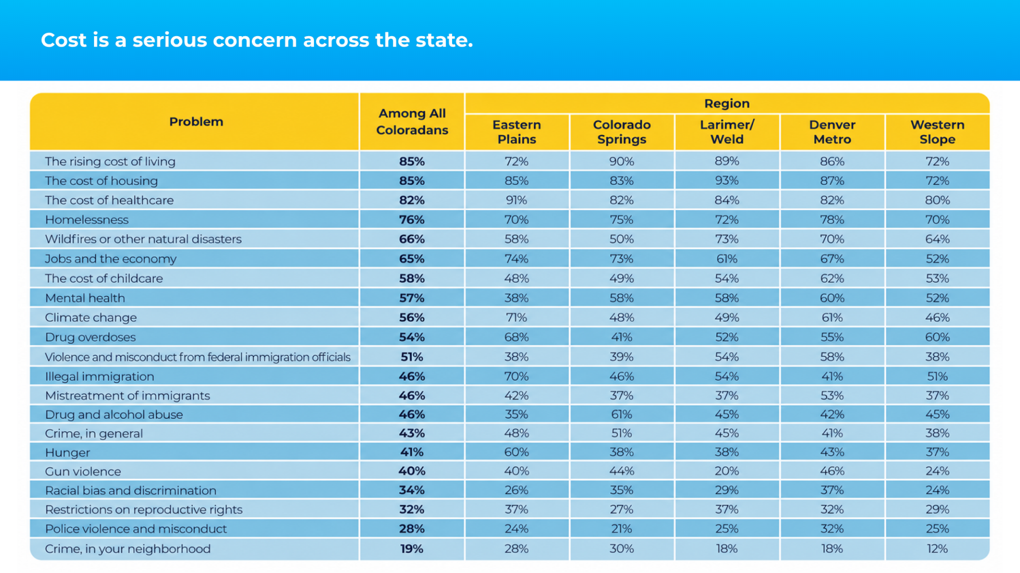
- 85% rate the cost of living as an extremely or very serious problem.
- 85% rate housing affordability as a serious problem.
- 82% say the cost of health care is a serious problem.
- Housing concerns are especially acute among younger generations, with 90% of Gen Z respondents and 94% of Millennials identifying housing costs as a serious concern.
“What we’re hearing is that financial pressure is a daily reality for many Coloradans, including those with higher incomes,” said Katie Peshek, senior communications officer with The Colorado Health Foundation. “Affordability challenges are creating persistent uncertainty, while frustration with government and political division continues to grow. The findings underscore how closely economic stability, health and well-being are connected.”
Cost is a serious concern across the state
Frustration with Government Continues to Rise
For the second consecutive year, and in the midst of a significant statewide election cycle, government and politics ranked as the top issue facing Colorado in an open-ended question.
- 28% identified government and politics as the state’s most important issue.
- 25% identified cost of living and inflation as the top issue.
- Among respondents experiencing mental health strain, financial concerns (35%), including loans and debt, and political concerns (28%) were the main source of stress.
- 72% are dissatisfied with how the government is responding to economic concerns.
“The fact that three-in-five Coloradans have experienced a serious financial challenge in the last year – an eight point increase from one year ago – is a troubling indicator that economic frustration continues to intensify, ” said Lori Weigel, Republican pollster for Pulse Poll and principal of New Bridge Strategy. “Nearly three-quarters say they are dissatisfied with how government leaders are responding to economic concerns.”
For small business owners like Maria Cooper who runs Tree of Life Childcare in Thornton, CO and is working to expand to a second location to serve the growing number of families in need of her services, rising business expenses and cost of living challenges for those she serves have created a ripple effect that jeopardizes her work and
“Opening a new location has been a real challenge,” said Tree of Life Childcare’s Maria Cooper. “We understand the need to comply with new permitting and staffing requirements, but these added expenses—combined with rising inflation—have significantly increased the cost of educational materials and the food we provide to the children we serve. In the end, these pressures force business decisions that affect many people. We decided to punish our income rather than punish families.”
Anxiety About the Future Is Growing but Hope Remains
Beyond current pressures, the poll reveals growing concern about Colorado’s long-term affordability.
- 37% say they are worse off financially than they were a year ago.
- 32% worry about losing their home because they cannot afford rent or mortgage payments.
- Only about one-quarter report living comfortably with savings.
“Financial challenges continue to rise as trust in institutions and government falls. Access to health care, affordable housing, food security and economic stability are becoming more urgent, not less,” said Janiece Mackey, Ph.D., co-founder and CEO of Young Aspiring Americans for Social & Political Activism (YAASPA). “What gives us hope is the next generation of Coloradans. Young people across our state are deeply engaged, eager to be part of the solution and using their voices to advocate for change in their communities. They understand that civic participation matters and that the future will be shaped by those who show up, speak out and stay involved."
“This moment calls for interracial and intergenerational commitments to move toward the world we envision. We as communities, philanthropic partners, and policymakers need to step forward, listen to communities and prioritize the investments and solutions that will strengthen health, opportunity and well-being for all Coloradans. The need is clear, and so is the responsibility to act."
About the Pulse Poll
The Colorado Health Foundation Pulse Poll is an annual statewide survey of Colorado residents that measures opinions, experiences and attitudes related to health and well-being.
The 2026 Pulse Poll was conducted by telephone and online from March 14–April 9, 2026 among a representative sample of 2,240 adults age 18 and older living in Colorado, including oversamples of Black/African American, American Indian/Alaska Native and Asian American Coloradans. The margin of sampling error for the full sample is ±3.2% at the 95% confidence level. For subgroup analyses, margins of error are higher.